Balcony Waterproofing in Florida: Why Balconies Leak and What a Lasting Repair Looks Like
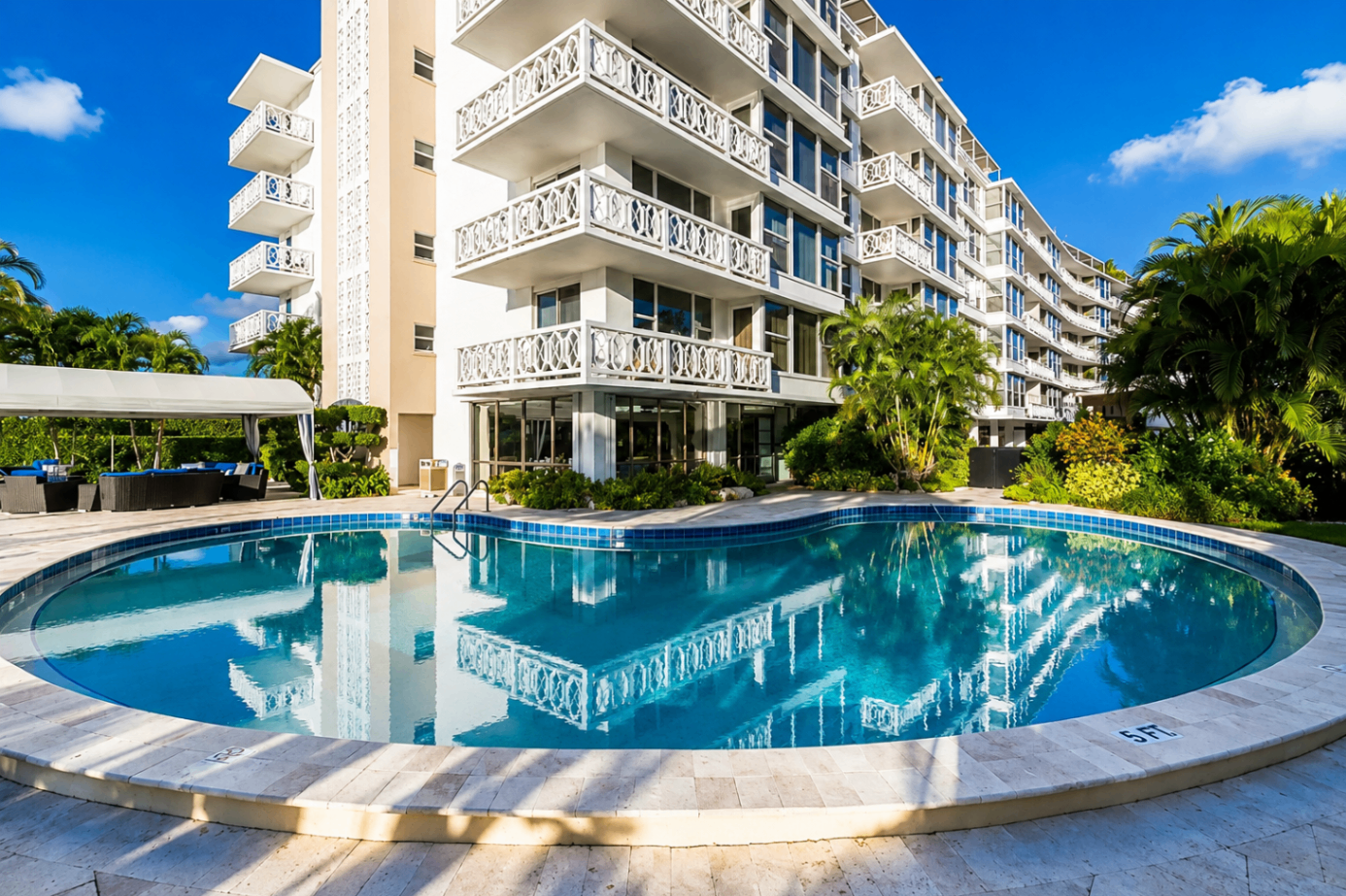
Balconies are the most exposed concrete on a Florida building. They take sun, salt, and wind-driven rain from above and at the edges, and they are full of weak points: door thresholds, railing posts, and slab edges. Most serious concrete damage on coastal buildings starts at a balcony.
Why balconies leak
A balcony is a flat slab that has to shed water without help from a roof. It leaks when water is allowed to sit on it or get into it. The usual causes are a surface with too little slope, or slope back toward the building; a waterproofing membrane that has worn out, or tile installed with no membrane under it; failed sealant at the door threshold and the wall; railing posts set into the slab, where water collects in the pocket around each post; and slab edges with no drip edge, so water runs back along the underside.
Warning signs
Look for water that is still standing a day after rain, cracked or loose tile, white mineral deposits on the slab edge or the ceiling below, rust stains at railing posts, cracked or bulging stucco at the edge, loose railings, and concrete that sounds hollow when tapped. Stains on the ceiling of the balcony below mean water is already passing through the slab.
Why it matters
Water that enters the slab carries salt to the reinforcing steel. The steel rusts, expands, and breaks the concrete around it. That cycle, and how it is repaired, is covered on our concrete restoration page. Balconies and their railings are also part of what an engineer examines during a milestone inspection, so damage that is ignored tends to come back later as a required structural repair.
How a lasting repair is done
- Investigate. Sound the slab, check slopes, and open selected areas to see the condition of the steel and the existing waterproofing.
- Remove finishes. Tile, old coatings, and failed sealants come off so the concrete can be seen.
- Repair the concrete. Damaged concrete is removed, the steel is cleaned and treated or replaced, and the slab is rebuilt under an engineer's direction where the damage is structural.
- Correct the slope. The surface is reshaped so water runs away from the door and off the edge or to a drain.
- Detail the weak points. Door thresholds, wall joints, railing posts, and slab edges get flashing, sealant, and drip edges. Railing posts are often re-anchored so they no longer sit in a pocket that holds water.
- Waterproof. A membrane or pedestrian traffic coating is applied over the prepared surface. Tile can go back on top only over a membrane designed for it.
- Test and protect. The surface is water tested before finishes go on, and the balcony stays closed until the coating has cured.
What goes wrong
The repairs that fail are the shortcuts: a new coating over damaged concrete, new tile over a slab with no membrane, sealant applied without fixing the slope, patching the one spot that broke while the rest of the slab is delaminated, and replacing the surface without dealing with the railing posts.
What drives the cost
Cost depends on the number of balconies and their size, how much concrete repair is found once finishes are removed, the access method for the height of the building, railing removal and reinstallation or replacement, the waterproofing system and finish chosen, door and stucco work at the perimeter, and phasing in an occupied building.
Florida considerations
Salt air speeds up corrosion, and buildings close to the coast see it soonest. Strong sun breaks down exposed coatings, so they need periodic recoating as maintenance. Wind-driven rain tests door thresholds in ways that ordinary rain does not. Balcony repairs on condominium and hotel buildings normally need a permit and an engineer's involvement when concrete or railings are affected.
Common follow-up questions
Can we install new tile over the existing balcony?
Only if the slab is sound, the slope is right, and a waterproofing membrane made for tile goes down first. Tile is a finish. It does not keep water out.
How long does a balcony coating last?
It depends on the product, sun exposure, and foot traffic. Exposed coatings are maintenance items. Plan on inspecting them regularly and recoating on the schedule the manufacturer recommends.
The bottom line
A balcony repair lasts when the concrete, the slope, the details, and the membrane are handled together. BellTower self-performs both the concrete repair and the waterproofing. See water intrusion and waterproofing or call (561) 225-1291.
Planning a project?
From brand-mandated hotel renovations to structural restorations, BellTower Associates delivers complex commercial projects on time and on budget across Florida.
Request a Bid